Leak 1: Denials
The first revenue leak: claim denials—11.8% denial rate, 65% never reworked
ANKA executes denial management as a critical component of end-to-end revenue cycle management. Every claim is worked. Every appeal is submitted.
Your team doesn’t have 500–1,000 hours per month to fight denials. ANKA does. It reads the EOB, generates the appeal, submits it, tracks the outcome, and reworks if denied again, with human oversight for exceptions.
Denial management is one of the core pillars of ANKA’s complete revenue cycle solution—alongside underpayment recovery and AR follow-up automation.
57%
Of Medicare Advantage denials get overturned on appeal—yet fewer than 1% are ever appealed.
The revenue exists. It’s just unworked.
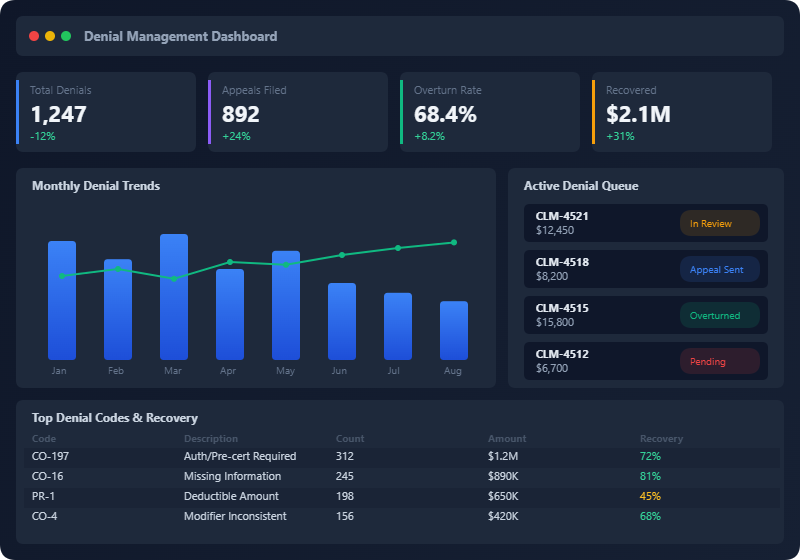
The Numbers
The denial crisis is a capacity crisis
When volume outpaces execution, revenue gets abandoned.The Process
How ANKA manages denials
Six steps. All executed. Zero abandoned claims.Reads the EOB
The payer sends the EOB. ANKA extracts the denial reason, claim amount, patient details, and required documentation within seconds. Your team doesn’t touch it.Pulls clinical documentation
ANKA searches your EHR for clinical history, operative notes, imaging reports, prior authorizations, and any supporting evidence. It cross-references against payer requirements. No manual chart retrieval is required.Writes the appeal
It generates a payer-specific appeal letter grounded in clinical evidence, aligned to the applicable medical policy and appeal format guidelines. The appeal is ready for submission in clear, factual language—not boilerplate.Routes for human review
Straightforward appeals move to the submission queue. Complex cases—missing documentation, unusual denials, high-dollar claims—are routed to your team. You review the 10% that require judgment. Everything else submits automatically.Submits to payer
Appeals are submitted via payer portal, EDI, or mail, depending on payer rules. Submissions are logged automatically. Timely filing deadlines are tracked. No appeals are lost in email inboxes.Tracks outcome and reworks
AI monitors appeal status. When the payer responds—paid or denied—ANKA flags it. If denied again, it reworks the appeal with a new clinical angle or additional documentation and escalates to your team if needed. No claim is abandoned.FAQs
Denial Management
ANKA analyzes each denial in context: payer appeal overturn rates, claim amount, clinical strength, and your contract with that payer. If the expected recovery exceeds the appeal cost, ANKA flags it for appeal. We track your outcomes by payer and adjust the threshold over time. Some payers have 70% overturn rates on appeals (worth pursuing aggressively). Others have 15% (we are more selective). You set the minimum recovery threshold. We apply math, not guesswork.
No. ANKA reworks denied appeals. If an initial appeal failed due to missing documentation, ANKA pulls additional clinical evidence and resubmits. If the denial was based on medical policy interpretation, ANKA tries a different clinical angle. The maximum number of appeal attempts depends on payer rules—usually two to three levels—but ANKA doesn’t abandon claims. It escalates to your team when human judgment is needed (unusual payer policy, contract dispute, etc.). No denial goes unworked simply because the first appeal failed.
ANKA appeals are generated from your actual clinical documentation and payer contracts. They are not templates—they are specific. Payers see clinical evidence, not a form letter. Appeal acceptance rates match those of human-written appeals for routine denials (medical necessity, missing documentation, coding errors). For complex denials, your team reviews before submission. We have mapped appeal requirements for 100+ payers and keep them updated as rules evolve.
For straightforward appeals (missing documentation, coding errors, medical necessity): hours. ANKA reads the denial, pulls the relevant documentation, writes the appeal, and submits it. Your team reviews if needed. Typical timeline: denial received to appeal submitted within 24–48 hours. Complex cases (missing clinical information, contract disputes, high-dollar claims) are routed to your team. No appeal sits waiting. Timely filing deadlines are treated as non-negotiable.
ANKA flags it. New denial codes, unusual payer rejections, or rare claim issues are routed directly to your team. ANKA learns from your team’s response. As ANKA sees more denial variations from your payers over time, it becomes increasingly autonomous. In the early weeks, you will see more flags. By month three, fewer. By month six, most denials are routine and ANKA handles them without routing. Your team trains the AI by providing the first response to novel denials.
The Full Picture